
Solutions
Forecasting & Decision Intelligence
Bring operational signals into planning and day-to-day decisions.
Forecasting & Decision Intelligence
Bring operational signals into planning and day-to-day decisions.
Built around your operating context
Planners, analytics owners and operational decision makers
Application · AI concept visualization · project scope
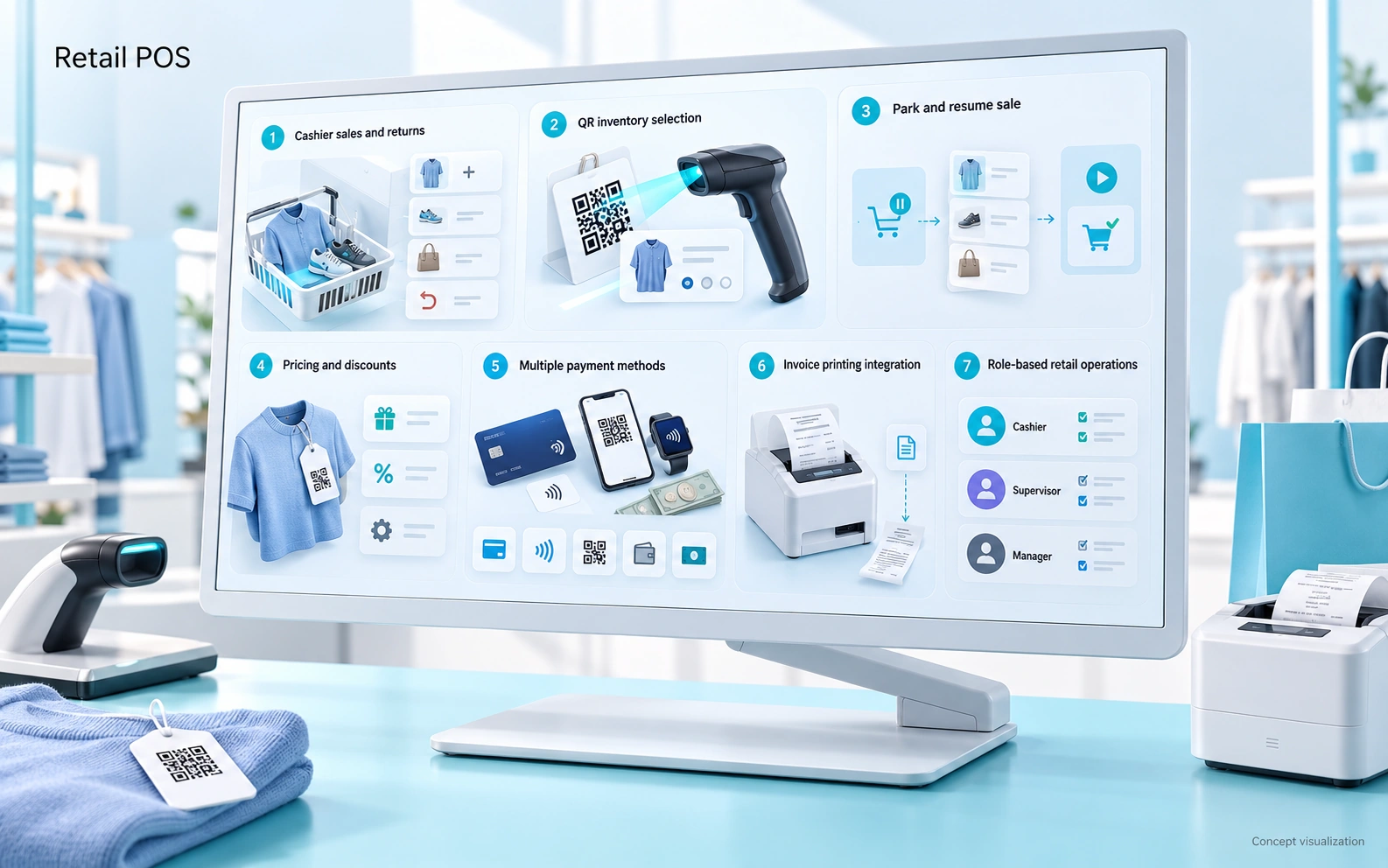
Retail POS
Cashier sales and returns · QR inventory selection · Park and resume sale
Planning and decision support
Turn signals into decisions people can assess.
Demand planning
Align sales, stock, availability and calendar data.
Explore the approach
Align sales, stock, availability and calendar data. Compare a proposed model with a simple baseline across relevant products and planning periods.
Exception-led action
Highlight situations that need review rather than filling a dashboard with predictions.
Explore the approach
Highlight situations that need review rather than filling a dashboard with predictions. Give planners the context to accept, adjust or reject a recommendation.
Ongoing evaluation
Monitor drift, missing feeds and changes in operating conditions.
Explore the approach
Monitor drift, missing feeds and changes in operating conditions. Retain the forecast version and observed outcome so future performance can be assessed.
Choose what your project needs
A clear scope.
A useful result.
Make the decision explicit
Identify the planning decision and the information available at that moment. Compare forecasts with a simple baseline, review uncertainty and define who can act on recommendations.
Scope the first release
Agree the process owner, connected systems and the smallest useful outcome. Review real examples and exceptions before committing to a wider rollout.
Prepare for enterprise delivery
Document responsibilities and review the controls appropriate to the engagement.
Role-based access and integration boundaries
Use role-based access and integration boundaries within the agreed scope of forecasting & decision intelligence. Define the responsible owner, the relevant source records and the checks that make the output useful.
Acceptance criteria and evaluation examples
Use acceptance criteria and evaluation examples within the agreed scope of forecasting & decision intelligence. Define the responsible owner, the relevant source records and the checks that make the output useful.
Release, rollback and support ownership
Use release, rollback and support ownership within the agreed scope of forecasting & decision intelligence. Define the responsible owner, the relevant source records and the checks that make the output useful.
From pilot to operation
Use working demonstrations and agreed checks to decide whether to expand, refine or stop. Confirm monitoring, documentation and ongoing improvement responsibilities before handover.
In project context
The work behind the possibilities.
AI concept visualization · project scope
Retail operations · Application
Retail POS
Cashier sales and returns · QR inventory selection · Park and resume sale

AI presentation artwork · design reference
Finance operations · Pre-production
Radiius
Customer and route assignments · Timestamped follow-ups · Promise and escalation tracking

AI concept visualization · project scope
Procurement · Prototype
ProcureOS AI
Command-center intake · ERP-context fixtures · Vendor shortlisting
Each project has its own scope and stage. Explore the profile for implementation details.
The path from idea to operation
Start focused.
Build with clarity.
- 01
Prepare
Establish the source records and the intended result.
- 02
Compare
Connect the approved sources and apply the task-specific checks.
- 03
Forecast
Review representative outputs and exceptions with the accountable owner.
- 04
Decide
Record the outcome, hand work to the responsible team and retain the information needed to investigate or improve the next run.
Deliverables & evaluation
What takes shape
Baseline and forecast evaluation views
Align sales, stock, availability and calendar data. Compare a proposed model with a simple baseline across relevant products and planning periods.
Planning exceptions and review queues
Highlight situations that need review rather than filling a dashboard with predictions. Give planners the context to accept, adjust or reject a recommendation.
Data-quality and model-monitoring definitions
Monitor drift, missing feeds and changes in operating conditions. Retain the forecast version and observed outcome so future performance can be assessed.
Know what good looks like
- Forecast error against an agreed baseline
- Performance by product, period and data coverage
- Planner overrides and usefulness of recommended actions
The current portfolio contains operational data and dashboard foundations, not independently verified forecasting results. Forecast performance must be established on the customer’s own evaluation data.
Bring the context. We’ll shape the next step.
From your world.
Into a working plan.
Source material
- Historical observations and timestamps
- Planning horizon and decision policy
- Availability and external context
- A baseline and representative evaluation periods
Systems to connect
- Approved operational data feeds
- Planning and inventory exports
- Analytics and reporting environments
Useful outputs
- Baseline and forecast evaluation views
- Planning exceptions and review queues
- Data-quality and model-monitoring definitions
Readiness checklist
Representative source material
Prepare historical observations and timestamps and planning horizon and decision policy. Start with approved or synthetic examples and identify gaps before introducing live records.
The right people in the room
Involve planners, analytics owners and operational decision makers. Identify who can confirm the workflow, review an exception and accept a release.
An agreed evaluation baseline
Define how you will assess forecast error against an agreed baseline. Record the current process and include difficult cases in the review set.
Good questions.
Clear answers.
What should we bring to a first conversation?
Bring historical observations and timestamps, planning horizon and decision policy, availability and external context, a baseline and representative evaluation periods. Include a person who knows the current process and can explain the difficult cases. An outline or synthetic example is sufficient for the first conversation.
What would the first release include?
Agree one bounded journey during discovery. A possible first output is baseline and forecast evaluation views, supported by a clear review owner and acceptance examples. Planning exceptions and review queues and Data-quality and model-monitoring definitions can be scoped where the operating case supports them.
Can this work with our existing systems?
We first review the available interfaces and access rules for approved operational data feeds, planning and inventory exports, analytics and reporting environments. An initial engagement can use approved exports where a direct integration is unavailable. Live updates require an agreed permission model and recovery path.
How are results and release readiness reviewed?
Agree examples, failure cases and acceptance criteria before the build. Review source traceability, correction effort, access boundaries and the handover into everyday operations. We do not promise a fixed saving or performance figure before that assessment.
The next useful step