
Expertise
AI Engineering
Build AI-assisted systems around real tasks, connected data and people who can verify the outcome.
AI Engineering
Build AI-assisted systems around real tasks, connected data and people who can verify the outcome.
Built around your operating context
AI product owners, knowledge teams and application engineers
Application · AI concept visualization · project scope
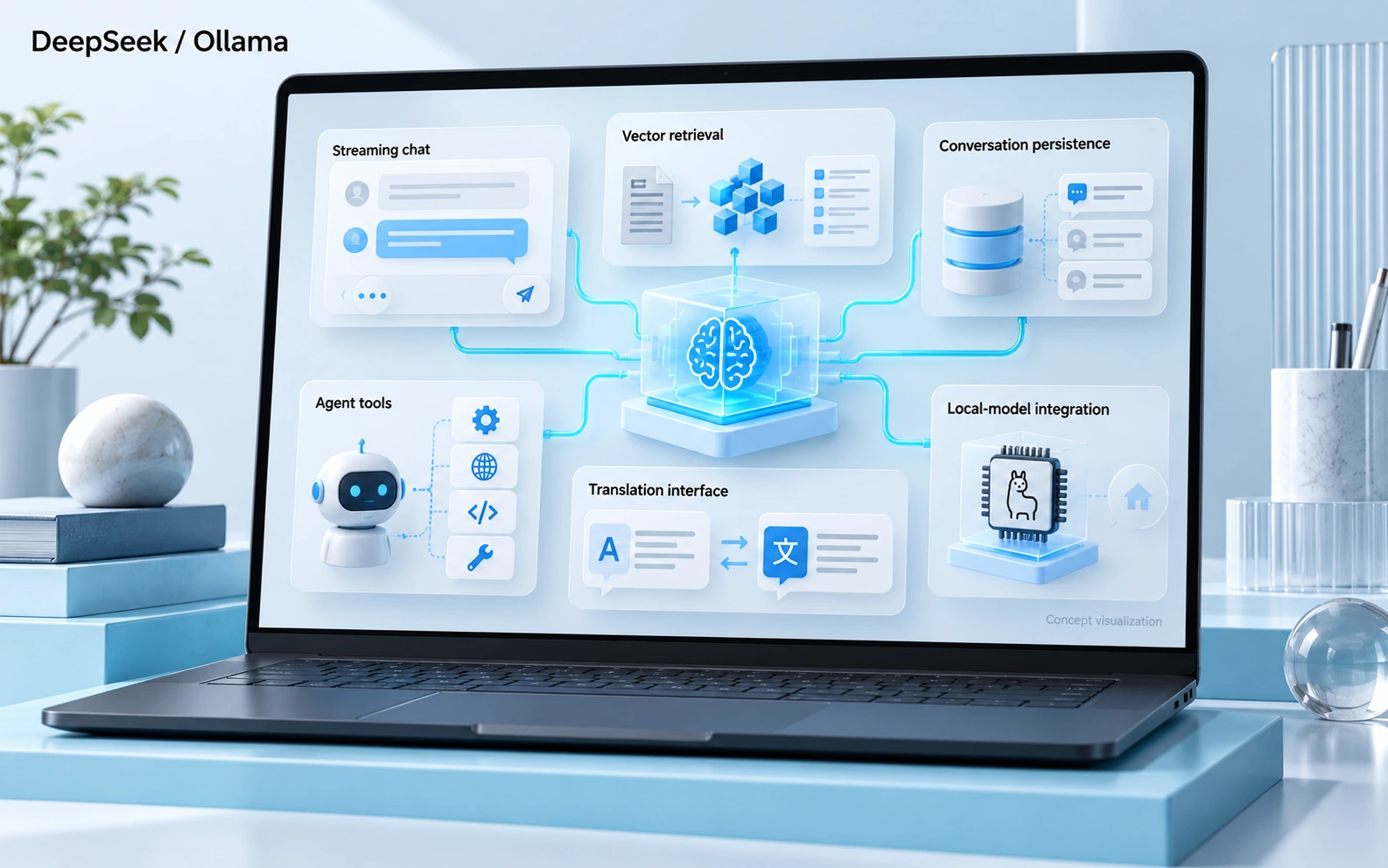
DeepSeek / Ollama
Streaming chat · Vector retrieval · Conversation persistence
Applied AI and knowledge systems
Useful intelligence needs a reviewable foundation.
Knowledge retrieval
Prepare source documents, define access boundaries and return answers with supporting references.
Explore the approach
Prepare source documents, define access boundaries and return answers with supporting references. Evaluate unsupported questions and outdated or contradictory material.
Tool-using agents
Define what the agent may read, draft and change.
Explore the approach
Define what the agent may read, draft and change. Use constrained tools, explicit approvals, timeouts and a recoverable record of each attempted action.
Workflow orchestration
Break a larger task into reviewable steps with typed handoffs and named owners.
Explore the approach
Break a larger task into reviewable steps with typed handoffs and named owners. Test partial failures, repeated events and escalation before a workflow runs unattended.
Choose what your project needs
A clear scope.
A useful result.
Our approach
Start with the business task and a representative set of examples. Choose retrieval, generation, prediction or a simpler rules-based approach according to the work.
Core focus areas
Select technologies according to the product constraints, integration requirements and the team that will maintain the system.
Agentic AI & Multi-Agent Orchestration
Break complex work into bounded tasks with defined tools, shared evidence and human handoffs. Evaluate the end-to-end workflow, including disagreement and failure paths.
AI Automation
Connect repeatable business events to checks, approvals and system updates. Keep the rules and exception ownership visible to the people responsible for the process.
Generative AI & LLMs
Use generation for drafting, summarizing and structured assistance where a reviewer can verify the result. Agree grounded sources, output formats and evaluation examples.
NLP & Chatbots
Classify requests, retrieve relevant context and support conversations around a defined task. Provide clear escalation when a question is outside the approved knowledge.
Computer Vision
Evaluate camera-based checks against representative images and changing field conditions. Identify what can be observed reliably before connecting detection outputs to operations.
Intelligent OCR / Document Processing (IDP)
Extract fields from agreed document types with references to the original record. Review confidence, missing fields and correction effort before expanding automation.
Predictive AI
Compare a model with a practical baseline and connect its output to a real planning decision. Review uncertainty, drift and the cost of incorrect recommendations.
Custom Workflows
Map the actual business rules, systems and handoffs before selecting tools. Build the smallest useful path through the workflow and make exceptions explicit.
From first release to ongoing improvement
Agree acceptance criteria, test the critical user journeys and document the release and support path.
In project context
The work behind the possibilities.
AI concept visualization · project scope
Knowledge management · Application
DeepSeek / Ollama
Streaming chat · Vector retrieval · Conversation persistence
AI concept visualization · project scope
Books and knowledge · Prototype
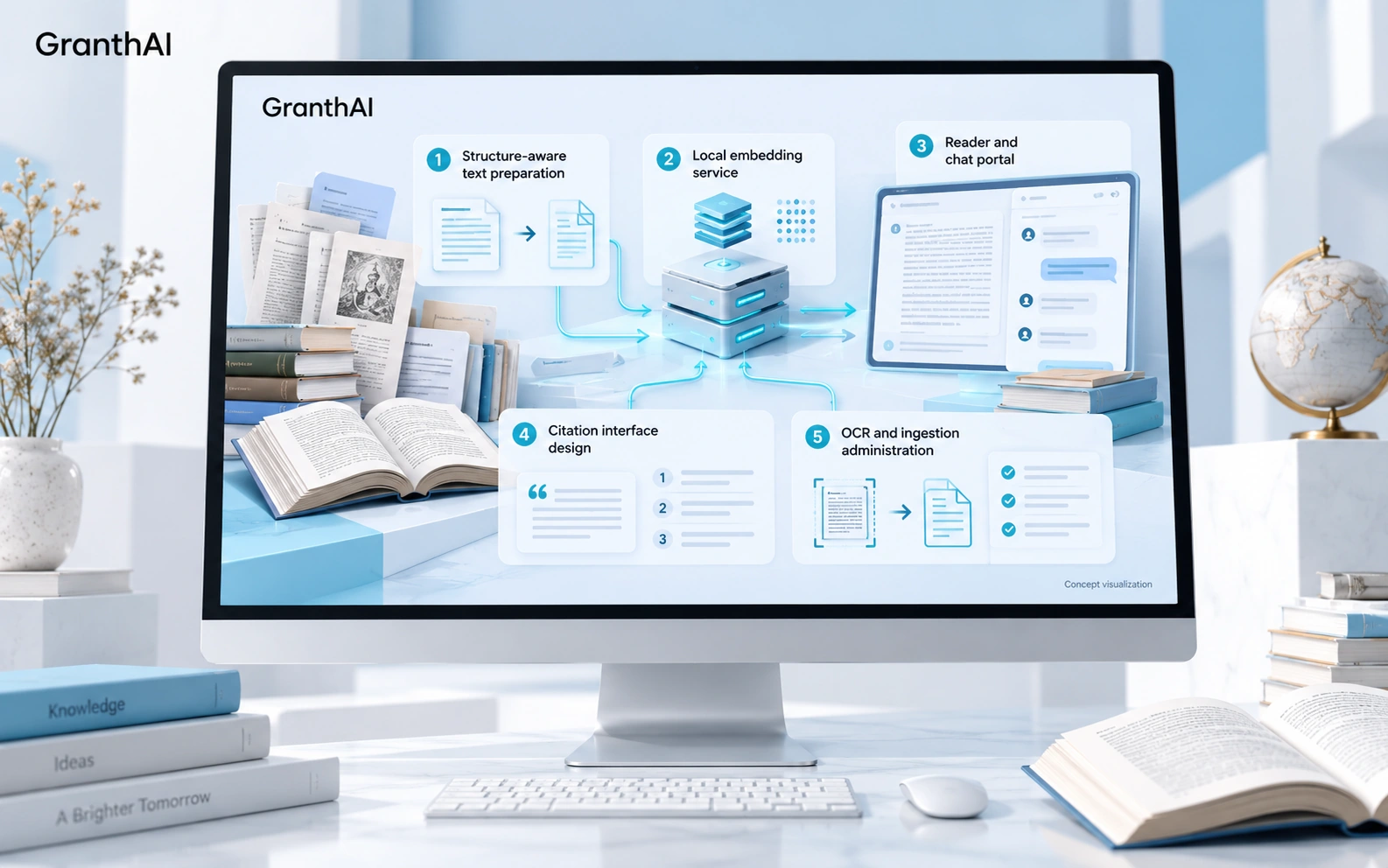
GranthAI
Structure-aware text preparation · Local embedding service · Reader and chat portal

AI concept visualization · project scope
Conversational AI · Framework
Open Avatar Chat
Speech pipeline integration · Modular model handlers · Avatar rendering
Each project has its own scope and stage. Explore the profile for implementation details.
The path from idea to operation
Start focused.
Build with clarity.
- 01
Receive
Establish the source records and the intended result.
- 02
Reason
Connect the approved sources and apply the task-specific checks.
- 03
Review
Review representative outputs and exceptions with the accountable owner.
- 04
Act
Record the outcome, hand work to the responsible team and retain the information needed to investigate or improve the next run.
Deliverables & evaluation
What takes shape
Source-grounded assistant workflows
Prepare source documents, define access boundaries and return answers with supporting references. Evaluate unsupported questions and outdated or contradictory material.
Constrained tool and agent integrations
Define what the agent may read, draft and change. Use constrained tools, explicit approvals, timeouts and a recoverable record of each attempted action.
Evaluation and operating handover materials
Break a larger task into reviewable steps with typed handoffs and named owners. Test partial failures, repeated events and escalation before a workflow runs unattended.
Know what good looks like
- Task completion on representative examples
- Grounding, citation quality and unsupported-answer rate
- Latency, cost, permissions and recovery behaviour
A model response is not evidence that an external action completed. Check tool results, protect restricted data and route uncertain or consequential decisions to a person.
Bring the context. We’ll shape the next step.
From your world.
Into a working plan.
Source material
- Approved source material
- Representative questions and tasks
- Role and tool-access boundaries
- Evaluation examples and review criteria
Systems to connect
- Approved model and retrieval interfaces
- Knowledge and document stores
- Identity systems and task-scoped business APIs
Useful outputs
- Source-grounded assistant workflows
- Constrained tool and agent integrations
- Evaluation and operating handover materials
Readiness checklist
Representative source material
Prepare approved source material and representative questions and tasks. Start with approved or synthetic examples and identify gaps before introducing live records.
The right people in the room
Involve ai product owners, knowledge teams and application engineers. Identify who can confirm the workflow, review an exception and accept a release.
An agreed evaluation baseline
Define how you will assess task completion on representative examples. Record the current process and include difficult cases in the review set.
Good questions.
Clear answers.
What should we bring to a first conversation?
Bring approved source material, representative questions and tasks, role and tool-access boundaries, evaluation examples and review criteria. Include a person who knows the current process and can explain the difficult cases. An outline or synthetic example is sufficient for the first conversation.
What would the first release include?
Agree one bounded journey during discovery. A possible first output is source-grounded assistant workflows, supported by a clear review owner and acceptance examples. Constrained tool and agent integrations and Evaluation and operating handover materials can be scoped where the operating case supports them.
Can this work with our existing systems?
We first review the available interfaces and access rules for approved model and retrieval interfaces, knowledge and document stores, identity systems and task-scoped business apis. An initial engagement can use approved exports where a direct integration is unavailable. Live updates require an agreed permission model and recovery path.
How are results and release readiness reviewed?
Agree examples, failure cases and acceptance criteria before the build. Review source traceability, correction effort, access boundaries and the handover into everyday operations. We do not promise a fixed saving or performance figure before that assessment.
The next useful step