The problem
What needed
to change.
Readers need to search multilingual books without losing the relationship between original passages and their explanations.

Project story
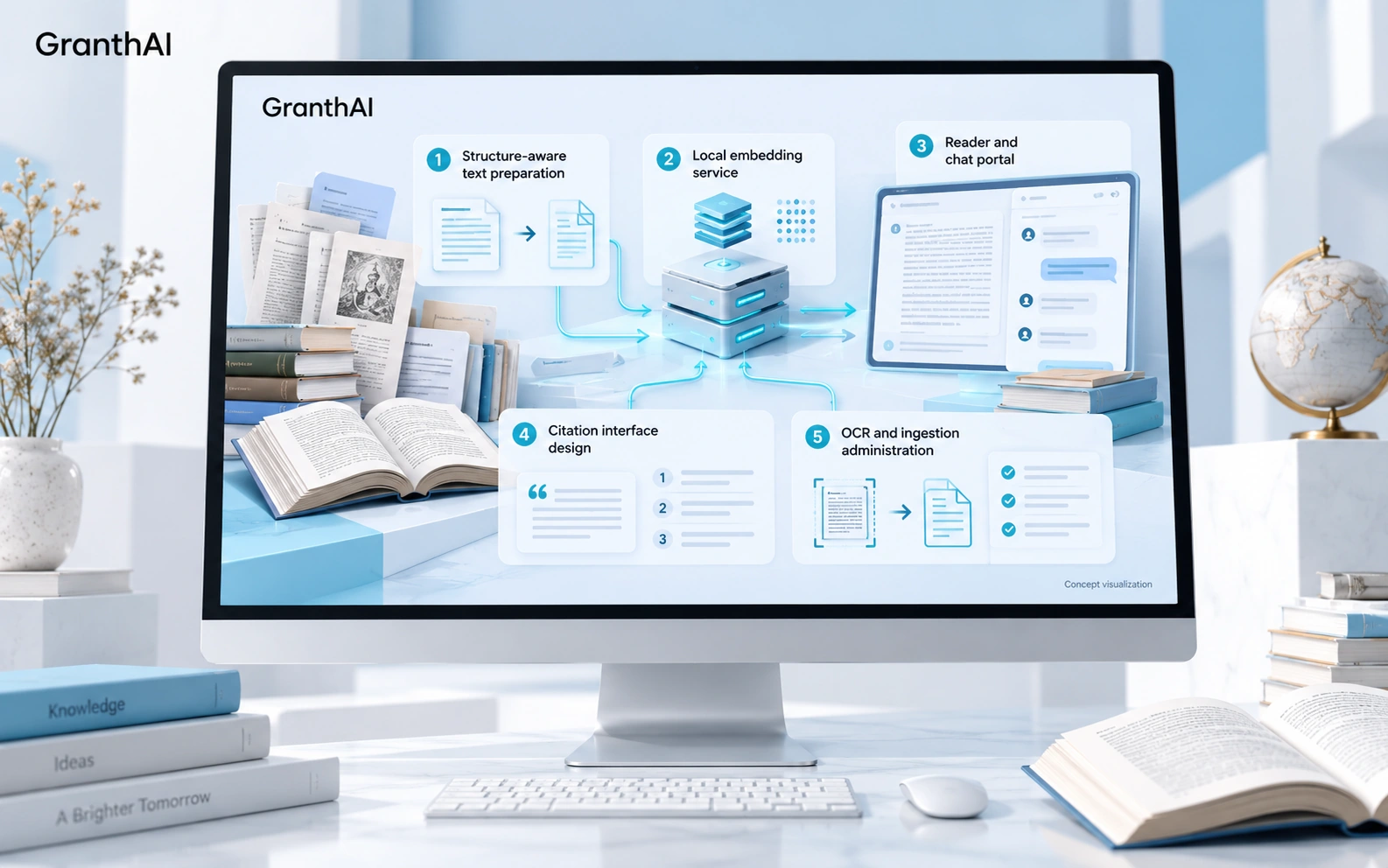
Document preparation and local embeddings support a planned reader/chat portal, while administration screens cover ingestion and quality review.
Document preparation and local embeddings support a planned reader/chat portal, while administration screens cover ingestion and quality review.
About the project
A book-based AI knowledge project with two complementary workspaces. The first holds Jain scripture PDFs, Gujarati Markdown conversions, chunking material, a frontend, and a local embedding service. The second provides a GranthAI-branded reader/chat portal and administrative interface.
Readers, students, researchers, and administrators working with Jain texts and a broader book knowledge collection.
The problem
Readers need to search multilingual books without losing the relationship between original passages and their explanations.
The solution
Document preparation and local embeddings support a planned reader/chat portal, while administration screens cover ingestion and quality review.
What we do
The capabilities and workflows that bring this project together.
Why we do it
Make large, multilingual text collections easier to search and question while retaining source passages and supporting the document-preparation work needed for retrieval.
Inside the workflow
The content side prepares documents and embeddings. The intended user portal offers books, search, chat, bookmarks, and history; admin screens cover ingestion, OCR monitoring, text correction, quality review, embeddings, analytics, and users.
A closer look
A visual guide to the project’s scope. An application screenshot is not available for this entry yet.
Technology
Next.js/React, Tailwind, Radix/shadcn-style components, Zustand, and a Node embedding API backed by a Python worker using F2LLM/sentence-transformer tooling.
Project scope
The UI planning file explicitly calls for mock data. Treat the two-portal feature set and large-library targets as intended scope, not proof of a fully integrated or populated production corpus.
From project to possibility